
 Available in US
Valorant Live Betting: Master In-Play Wagering for Maximum Profit
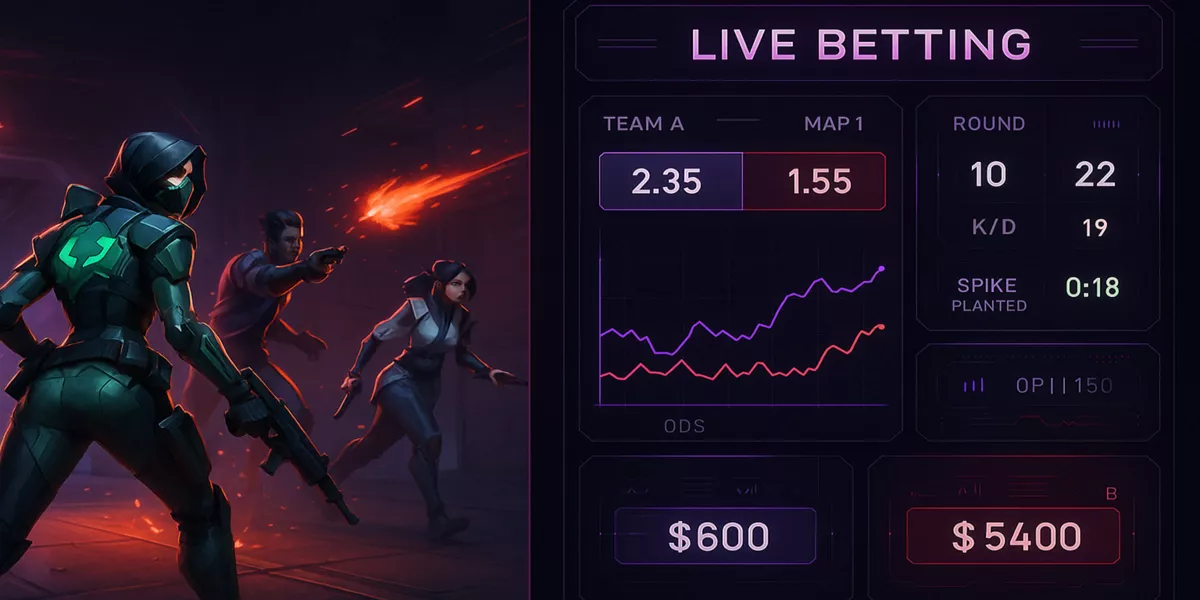
Real-time Valorant betting interface with live odds and economic indicators
Live betting transforms Valorant wagering from a pre-match analysis exercise into a dynamic real-time activity where information advantages actually matter. When you’re watching a match unfold with understanding of game mechanics, economic states, and team psychology, you see opportunities that bookmakers can’t price accurately because they’re reacting to score changes without context.
The difference between profitable live betting and donating money to bookmakers comes down to speed, knowledge, and discipline. Speed because odds move constantly and opportunities disappear in seconds. Knowledge because you need to recognize when game state diverges from what the score suggests. Discipline because live betting creates temptation to fire off bets based on excitement rather than edge. Most people fail at live betting not because they lack understanding but because they can’t resist betting every interesting moment.
This guide covers everything specific to succeeding at Valorant live betting. Understanding how in-play odds work differently than pre-match lines, which game states create value opportunities, reading economic advantages that bookmakers misprice, identifying real momentum versus variance, knowing when to bet during a match versus sitting out, and managing the psychological challenges unique to real-time wagering. Live betting can be significantly more profitable than pre-match betting for those willing to put in the work, but it can also accelerate losses for those who treat it as entertainment rather than systematic edge-seeking.
How Live Betting Odds Actually Function
Live betting markets operate fundamentally differently than pre-match markets. Understanding these differences prevents costly mistakes and reveals where opportunities exist.
Bookmakers set pre-match odds based on statistical models incorporating team strength, recent form, head-to-head records, map pools, and various other factors. Once the match starts, live odds update constantly based on current score and game state. The model becomes simpler whoever’s winning gets shorter odds, whoever’s losing gets longer odds, with adjustments based on the magnitude of the lead and time remaining.
This simplification creates exploitable inefficiencies. Bookmakers are mostly reacting to score without deeply understanding why that score exists or whether it’s sustainable. A team down 0-5 on a map sees their odds balloon to +300 or higher to win that map. But you watching the match might recognize those five rounds were competitive and the losing team actually has favorable economic position for the next several rounds. The score looks bad but the actual game state isn’t as dire as odds suggest.
Live odds carry higher margins than pre-match odds. Bookmakers build in extra edge to protect against bettors who have information they don’t like watching with a slight delay that lets you bet knowing what happened before odds adjust. This margin increase makes live betting inherently harder than pre-match betting. You need bigger edges to overcome the house advantage.
Odds update frequency varies by bookmaker and match importance. Major VCT matches might see odds updating every few seconds during active rounds. Smaller tournaments might update every thirty seconds or minute. The lag between actual game events and odds adjustment is where value hides. If you’re watching live and odds haven’t caught up to current game state, you can bet at prices that are already obsolete.
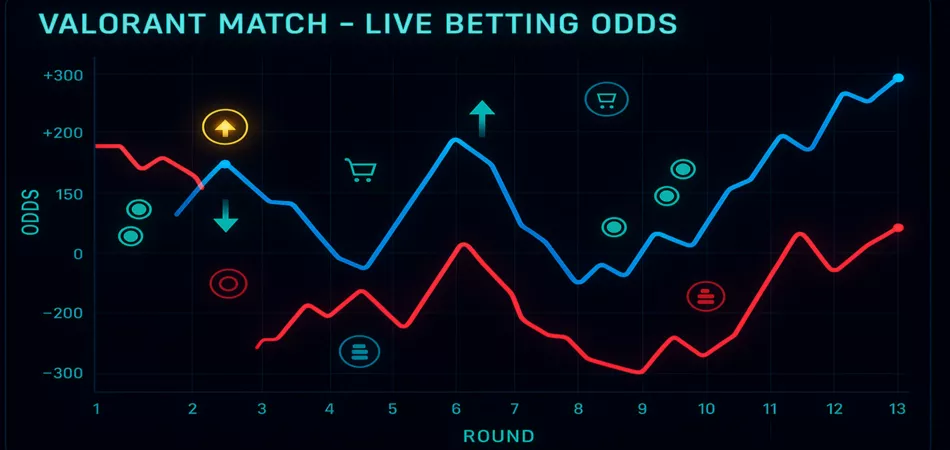
Live odds movement analysis showing key betting opportunities during match progression
Most bookmakers limit maximum bet sizes on live markets compared to pre-match. They’re protecting themselves from sharp bettors exploiting information advantages. You might be able to bet five hundred dollars pre-match but only one hundred dollars live. This limits profit potential but also limits your risk when you’re wrong. Start with smaller live bets until you prove to yourself you actually have edges.
Understanding how bookmakers calculate live odds helps predict movement. They weight recent rounds heavily a team winning the last three rounds sees bigger odds adjustment than if those same three wins were spread throughout the map. Recency bias is built into algorithms. You can exploit this by recognizing when recent rounds aren’t predictive of upcoming rounds due to economic factors or random variance.
Economic State as Primary Live Betting Edge
The single biggest advantage for Valorant live bettors is understanding economic state. Casual bettors and bookmaker algorithms focus on score. Informed bettors track credits and can predict round outcomes more accurately.
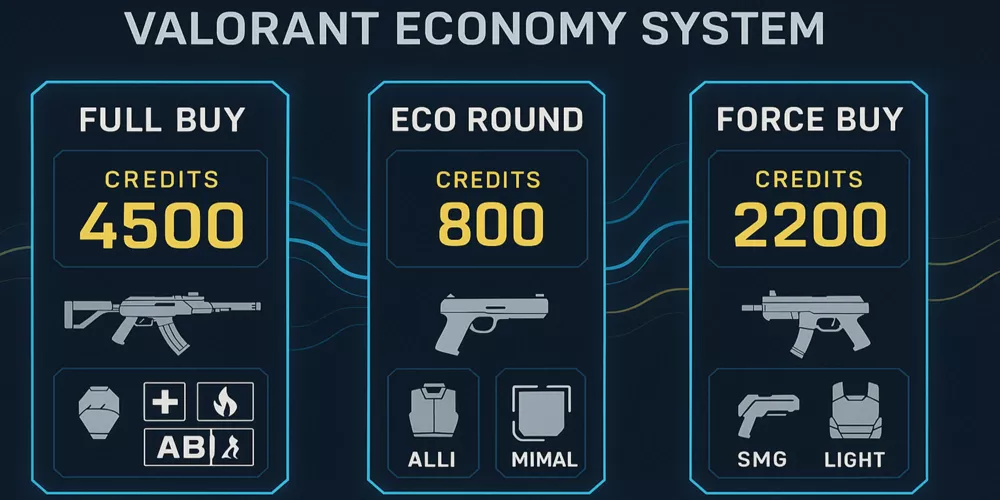
Economic state comparison: Full Buy vs Eco Round vs Force Buy scenarios
Each round in Valorant has an economic profile. Full buy rounds feature both teams with rifles, armor, and abilities. Eco rounds see one team with pistols and minimal utility while the opponent has full equipment. Force buy rounds are partial maybe SMGs with light armor or pistols with full utility. Each scenario creates different win probabilities that score alone doesn’t reveal.
When you’re watching live, track each team’s credits after every round. Starting credits, round win bonuses, loss streak bonuses, equipment costs add it up. You don’t need exact numbers, just relative sense of which team can buy what. After a few matches of practice, this becomes automatic.
The most exploitable situations are when one team is on full buy and the other is forced to eco. The team with guns should win 80% or higher of these rounds. But live odds often price them at only -200 or -250, implying 66-71% win probability. That five to fifteen percentage point gap represents value. Make this bet repeatedly across multiple matches and you profit long-term despite losing occasionally to lucky eco round wins.
Conversely, when a broke team somehow wins an eco round, live odds often overreact. That team is still broke for the following round unless they got enough kills to build partial economy. The opponent still has economy advantage. Don’t let one unlikely eco victory convince you the momentum has completely shifted. Check the credits if the eco round winner is still economically disadvantaged next round, they remain underdogs regardless of the brief morale boost.
Force buy rounds create more variance than full buys or ecos. The broke team has some firepower but not full capability. Maybe they can take some aim duels but lack utility to execute properly. These rounds are closer to 60-40 or 55-45 rather than 80-20. Understanding when teams force versus eco requires knowing team tendencies. Some teams almost always force, others save religiously. This knowledge helps predict round outcomes.
Watch for economic resets where both teams essentially start fresh. This happens after a team loses several consecutive rounds while the winning team accumulated maximum economy. The multi-round economic advantage disappears and the matchup becomes more even temporarily. If you were betting based on economic edge and a reset occurs, pause and reassess rather than assuming your previous advantage persists.
Pistol rounds at the start of each half create economic cascades. Win the pistol round, you probably win the following two rounds due to economy advantage. Statistics consistently show pistol round winners take 70% or more of the subsequent two rounds. The pistol round itself is a coin flip both teams have similar equipment. But the economic advantage it creates is massive. Some bookmakers offer pistol round specific betting markets that can be profitable if you identify teams with strong pistol strategies.
Reading Momentum Versus Variance
Live betting requires distinguishing between real momentum that will persist and random variance that looks like momentum but will regress. This separation is the hardest skill to develop and the most valuable.
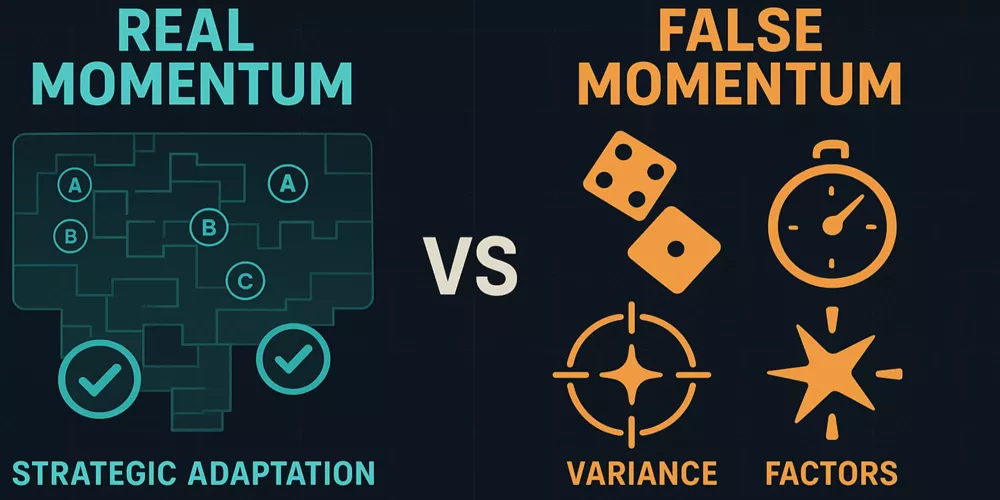
Understanding the difference between strategic momentum and random variance
Real momentum comes from strategic adaptation. Maybe a team figured out where their opponent defaults and started stacking defenders there. Or they identified which player is struggling and keep targeting him in duels. These mid-match adjustments create genuine edges that persist for multiple rounds. When you see strategic adaptation happening, bet accordingly even if the score doesn’t dramatically reflect the advantage yet.
False momentum is variance creating a streak that looks dominant but isn’t sustainable. Maybe the attacking team won three straight rounds but all three came down to winning crucial 1v1 clutches. The rounds were actually close, not dominant performances. The score shows 3-0 streak but the gameplay was competitive. This false momentum will regress when clutch situations stop going favorably.
Similarly, a team might lose three rounds in a row due to unlucky timings or random factors. They played the rounds correctly but got caught by unfortunate peaks or lost to lucky spray transfers. The losing team isn’t playing badly variance just went against them temporarily. When you identify this, don’t overreact to the recent streak. The fundamentals suggest upcoming rounds will be more competitive than the recent results indicate.
Conversely, confidence momentum matters. A team that wins a crucial round through superior strategy or clutch performance often carries that confidence forward. They make decisive plays, take calculated risks that pay off, and play fearlessly. Confidence is self-reinforcing in the short term. Riding confident teams for a few rounds can be profitable before the effect fades.
The danger is distinguishing confidence from overconfidence. Overconfident teams start making sloppy mistakes because they assume they’ll win any situation. They stop respecting the opponent, take unnecessary risks, and give away rounds through carelessness. This shift from confidence to overconfidence happens suddenly and creates value betting against the previously hot team.
Map dynamics affect momentum interpretation. Attacking-sided maps like Haven or Bind naturally create attacker streaks that don’t indicate actual momentum. Defender-sided maps like Split or Icebox create defender streaks. Knowing map tendencies prevents overreacting to streaks that are just the map being played correctly rather than genuine momentum shifts.
Optimal Timing for Live Bets
When you place live bets during a match matters as much as which team you bet. Understanding match flow reveals the best moments to enter positions.
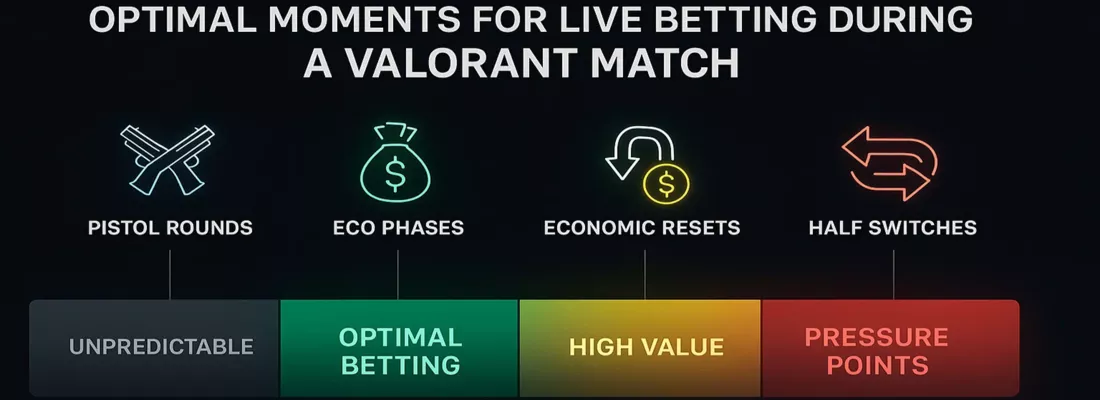
Strategic betting timeline highlighting high-value moments throughout a Valorant match
The first few rounds of each half are relatively unpredictable. Teams are probing, establishing defaults, feeling out opponent tendencies. Neither side has adapted to the other yet. Live betting early rounds is mostly guesswork unless you have specific information about pistol round tendencies or opening strategies. Wait for the match to develop before committing capital.
Rounds four through eight typically offer the most clarity. Both teams established patterns, showed their standard setups, and gave you information about their capabilities. You can now assess which team is better positioned strategically and whether odds accurately reflect that advantage. This middle section of each half is often the most profitable time for live betting.
Economic transition moments create opportunities. After a team loses their full buy round, you know they’re going into eco mode for the next round or two. The live odds might not fully reflect the upcoming economic disadvantage. Bet before the eco round starts rather than during it, because once the round begins and people see the pistols versus rifles, odds will adjust.
Key score thresholds create psychological pressure that affects teams differently. When the score reaches 8-8 or 10-10, some teams elevate their play while others tighten up. Teams fighting for the crucial 11th round that puts them one away from winning often show their true mental fortitude. Watch how teams handle these pressure moments to assess whether their odds at key thresholds are accurate.
The final rounds before half switch often see different intensity levels. A team up 9-3 heading into the last round of the half might play loose, willing to gamble on aggressive plays because they have a comfortable lead. The team down 3-9 is desperate and might force unnecessary risks trying to salvage something before half. These altered motivations affect round outcomes in ways score-based odds don’t capture.
Map transitions between maps in a series create opportunities. After map one completes, odds for map two get posted based on the map one result and overall series score. But map-specific advantages don’t always correlate with map one results. If Team A won map one but map two is historically their weak map against an opponent who specializes there, the odds might not adjust enough for the map-specific dynamics. Bet before map two starts while odds are still influenced by map one outcomes.
Live Betting Markets Beyond Match Winners
Different live betting markets offer different edges. Understanding which markets are softer helps direct your action to where advantages actually exist.
Live match winner odds are the most efficient market because the highest volume flows through them. Beating live match winner consistently is difficult because bookmakers focus most attention on pricing these accurately. Unless you have significant information or analytical advantages, you’ll struggle to find consistent value in live match winners.
Live map winner odds are softer than match winners. Less volume, less attention, more opportunities for mispricing. If you’re watching and recognize that one team is dominating the map despite the score being close, map winner odds might not fully reflect that dominance yet. Similarly, a team down significantly might have realistic comeback chances based on upcoming economic advantages that map winner odds underestimate.
Specific round milestone bets like “will Team A reach 8 rounds” when they’re currently at 5-7 down require predicting comeback potential. These bets are mostly about economic advantages and strategic adaptations. Can the losing team stabilize economically and mount a comeback? Or is the winner too far ahead economically to be caught? These bets are softer than main markets because fewer people understand the factors determining outcomes.
Prop bets during live matches next player eliminated, specific player to get next kill, bomb plant yes/no are extremely soft markets that some bookmakers offer. The pricing is mostly guesswork because these granular outcomes depend on so many variables. If you have deep game understanding and watch intensely, you might identify edges, but the cognitive load is high and potential profit is limited by low bet limits.
Managing Live Betting Psychology
Live betting creates unique psychological challenges that pre-match betting doesn’t. The real-time nature, constant odds movement, and immediate results create emotional intensity that leads to mistakes.
The sunk cost fallacy manifests when you’re losing live bets. You bet Team A to win the map, they fall behind, and now you’re considering doubling down to “get even” or prove your initial read was correct. Your previous bet is sunk cost it’s gone regardless of what you do now. Make each new betting decision independently based on current game state, not trying to salvage previous mistakes.
FOMO drives betting marginal opportunities. You’re watching a match, haven’t bet yet, feel like you’re missing out. So you force a bet on a round that doesn’t really offer value because you want to be involved. This is donating money to bookmakers. Some matches you’ll watch entirely without betting because genuine edges never appear. That’s fine. Embrace boredom when value isn’t present.
Set strict limits before matches start. Maybe your rule is maximum three live bets per map. Or maximum five percent of bankroll in live action per match. Having predetermined limits prevents getting carried away in the moment and betting too much too frequently. Stick to your limits even when you feel like you’re seeing tons of value that feeling might be your brain making up reasons to get action rather than genuine edge identification.
Take breaks between maps in a series. Step away from the screen, clear your head, reset emotionally. Starting fresh for map two prevents carrying baggage from map one results affecting your decisions. This is especially important if map one live betting went poorly you need to reset mentally rather than trying to recover.
Technical Setup for Live Betting Success
Your practical setup for watching and betting live significantly impacts your success rate. Optimization in these areas creates edges.
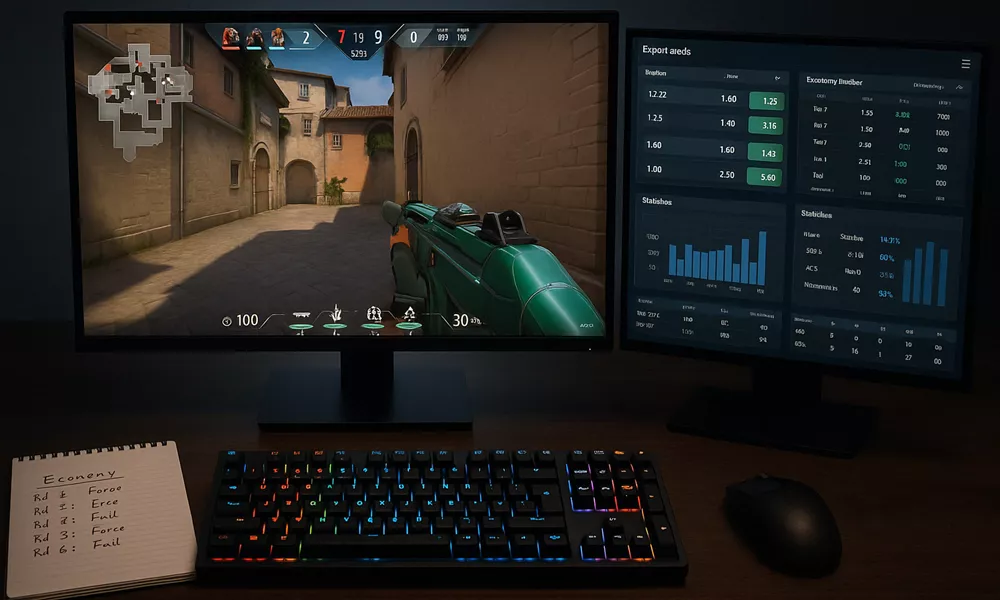
Optimized live betting workspace setup for maximum efficiency and focus
Stream quality and delay matter immensely. Watch the highest quality stream available with the shortest delay. Twitch typically has lower delay than YouTube. Some betting sites offer integrated streams with even lower latency. The closer you are to real-time action, the bigger your information advantage before odds adjust. Even five or ten seconds difference matters when odds update constantly.
Keep a notepad or spreadsheet open to track each team’s economy if you’re not doing it mentally. After each round, jot down approximate credits for both teams. This written reference prevents you from losing track during intense match moments. You don’t need exact numbers knowing Team A has “full buy” while Team B is “eco” is sufficient.
Minimize distractions in your environment. Live betting requires intense focus. Having TV on in the background, checking phone constantly, or half-watching while doing other activities means you miss the subtle cues that indicate value opportunities. When you’re live betting, commit to actually focusing for the match duration.
Common Live Betting Mistakes
Even experienced bettors make specific errors when live betting that they’d never make pre-match. Awareness of these patterns helps avoid them.
Betting too frequently is the most common mistake. Live betting is exciting, odds move constantly, and your brain wants action. But most moments don’t offer genuine edges. Betting every interesting round means you’re making negative expected value bets most of the time. Professional live bettors might only bet three or four rounds across an entire map because those are the only spots where they identified real advantages.
Betting without watching the match removes your entire edge. Some bettors check scores, see one team up 5-2, bet them to extend the lead without watching a single round. You have no idea whether that lead is sustainable, whether strategic adjustments are happening, whether tilt is setting in. If you’re not watching, you shouldn’t be live betting. The whole advantage comes from real-time information that scores don’t capture.
Betting predictable situations at bad odds wastes money. Full buy versus eco rounds are highly predictable the team with guns should win 80% of the time. But bookmakers know this too. They’ll offer -250 or worse on the full buy team, making the bet marginally profitable at best. You’re better off waiting for less obvious situations where you have genuine information edges.
Failing to cash out when situations change is stubbornness. You bet Team A to win the map, they take a solid 7-4 lead, now odds let you cash out for eighty percent of potential profit. But suddenly Team B figures something out and goes on a streak. Team A still wins, but the match gets closer than expected, and your profit margin shrinks. Sometimes locking in early profit when situations change is the smart play. Don’t let pride prevent you from adapting.
Building Live Betting Skill Systematically
Live betting expertise develops through deliberate practice and systematic skill building. You won’t master it by casually betting matches whenever you happen to be watching.
Start by watching matches without betting at all. Track what you would have bet, what odds were available, what the outcomes were. After each match, review whether your theoretical bets would have won or lost. This risk-free practice lets you develop pattern recognition and economic tracking skills without losing money during the learning curve.
Focus on one region or tournament type initially rather than trying to live bet everything. If you’re watching and analyzing VCT Americas matches exclusively, you’ll develop deeper understanding of team tendencies, player capabilities, and tactical patterns that create live betting edges. Generalists get crushed by specialists in live betting.
Study matches after they complete by rewatching VODs and analyzing your live betting decisions. With the benefit of hindsight, were there indicators you missed that would’ve changed your bets? Did you correctly identify economic advantages? Were there tells about tilt or momentum that you didn’t recognize in real-time but are obvious when watching afterward?
Find other successful live bettors to discuss strategy with. Live betting is isolating because everything happens in real-time you can’t pause and consult others mid-match. But discussing approaches, sharing observations about match patterns, and comparing notes on what creates value helps accelerate learning.
Advanced Live Betting Concepts
Once you’ve mastered fundamentals, advanced concepts create additional edges for sophisticated live bettors.
Correlated betting during matches involves placing multiple related bets that compound if your analysis is correct. Maybe you bet the full buy team to win the next round based on economy, then separately bet over on total rounds for the map because you expect the match to go long due to both teams having deep map pools. These bets correlate both become more likely if your assessment about competitive map dynamics is correct.
Middle opportunities occasionally appear in live betting when odds move significantly. Maybe you bet Team A at +150 to win the map when they were down 4-7. They fight back to 9-9, and now you can bet Team B at +160. Regardless of who wins, you profit. These middles are rare and require quick recognition and execution, but they’re free money when available.
Arbitrage in live markets happens when different bookmakers have divergent odds on the same outcome. Site A has Team A at -150 to win the map, Site B has Team B at +180. You can bet both sides for guaranteed profit. These opportunities disappear within seconds and require having multiple accounts open simultaneously. The profit margins are small, but they’re risk-free.
Hedging pre-match positions using live betting creates guaranteed profit situations. You bet Team A at +200 pre-match to win the series. They take a 1-0 map lead, and now Team B is available at +150 to win the series. You can bet Team B live and guarantee profit regardless of final result. Whether to hedge depends on your confidence in the original bet and profit maximization calculations, but the option exists.
Betting streaks requires extreme discipline but can be profitable. If you identify that Team A is on legitimate momentum and likely to win the next three rounds, you can bet each round successively at plus-odds and compound profits. The risk is momentum reverses, and you compound losses instead. Only pursue streak betting when you have high confidence in sustained advantage, not just because you won the last bet.
The Reality of Live Betting Profitability
Live betting can be more profitable than pre-match betting for skilled practitioners, but it requires significantly more work and carries higher variance.
Your edge in live betting comes from real-time information processing that bookmakers can’t match. You see strategic adjustments, tilt, economic advantages, and tactical patterns that score-based algorithms miss. This information edge is real and exploitable but also fleeting. The moment significant money comes in on one side, bookmakers adjust and your edge disappears.
For those willing to put in the work watching matches carefully, tracking economics, maintaining discipline, betting selectively live betting offers edges that increasingly efficient pre-match markets don’t provide. The combination of real-time information advantages and bookmaker algorithm limitations creates value for sophisticated bettors. But it’s not easy money, it’s not for everyone, and it requires honest assessment of whether you’re actually finding edges or just fooling yourself while the excitement of real-time betting masks losses.
Navigate back to the main hub for daily updates.
Live odds fluctuate rapidly during major offline events, which is detailed in our VCT betting guide.
