


Valorant betting exploded faster than most people expected. When Riot Games dropped their tactical shooter in 2020, bookmakers scrambled to add markets. Five years later, we're looking at a multi-million dollar betting ecosystem that rivals CS:GO's mature scene. The difference? Valorant was built for esports from day one, and it shows in every aspect of competitive play.
If you're here, you probably fall into one of two camps. Either you've watched enough VCT matches to recognize when a team's economic advantage guarantees the next three rounds, or you're curious about this whole esports betting thing and Valorant seems less intimidating than Dota 2's hundred-hero roster. Both positions are valid starting points.
This guide won't promise you'll quit your job and live off Valorant betting. That's fantasy land. What I can offer is a thorough breakdown of how this market actually works, where the real edges exist, and why most bettors lose money while a small percentage consistently profits. The gap between these groups isn't luck or some secret system. It's understanding game mechanics, recognizing value in odds, and having the discipline to walk away when the smart play is no play at all.
We're covering everything from basic bet types to advanced statistical analysis. You'll learn how to read American odds without a calculator, why the pistol round matters more than you think, and which betting markets the bookmakers price incorrectly because they're still learning Valorant's unique rhythm. Whether you're placing your first five-dollar bet or looking to refine a strategy that's been break-even for six months, there's something here that'll click.
One thing upfront though. Valorant betting is gambling. The house has an edge built into every line. You're fighting against that edge, against other sharp bettors, and against your own psychology when a bad beat makes you want to immediately fire off three revenge bets. Most people lose. That's the reality. But with proper bankroll management, actual research beyond checking which team won last week, and realistic expectations, you can absolutely enjoy this hobby while staying profitable or at worst breaking even. Let's get into how that works.
What is Valorant Betting and Why It's Exploding in 2026
Betting on Valorant means wagering real money on the outcome of professional matches. Simple enough concept. But the execution differs from traditional sports in ways that create both opportunities and traps for bettors who don't adjust their approach.
Riot Games learned from their League of Legends success and designed Valorant with competitive integrity baked into the foundation. Server tick rates, anti-cheat systems, tournament infrastructure everything optimized for fair competition. This matters for betting because match-fixing is the death of any betting market. When you can reasonably trust that pro players are trying to win, the entire analytical framework becomes viable. Contrast this with some tier-three esports where sketchy results happen regularly enough to make betting essentially random.
The Valorant Champions Tour launched in 2021 with a clear roadmap. Four regional leagues feeding into international Masters events, culminating in the world championship called Champions. Prize pools reaching two million dollars. Organizations like Sentinels, FunPlus Phoenix, and Paper Rex building dedicated rosters. This structure created consistency that bookmakers need. They can set accurate lines when they know teams are playing weekly matches instead of sporadic tournaments with massive roster changes.
What makes Valorant specifically interesting for betting is the hybrid nature of the game itself. You've got Counter-Strike's tactical depth with weapon economy, site executes, and utility management. Layer on top Overwatch-style agents with unique abilities that can completely swing rounds. This combination creates more variance than pure aim-based shooters, but less chaos than ability-focused games. For bettors, variance is opportunity. When outcomes aren't predetermined by simple skill gaps, edges exist in understanding how different factors interact.
The betting market has matured rapidly. Five years ago, you'd find maybe three bookmakers offering Valorant lines, usually just match winners with terrible odds. Now? Every major sportsbook has dedicated Valorant sections with dozens of markets per match. Over-under rounds, map handicaps, first kill props, pistol round winners. The depth of available bets creates more angles to find value but also more ways to lose money on markets you don't truly understand.
Current market size estimates put Valorant betting volume in the hundreds of millions annually. That's still smaller than traditional sports or even League of Legends, but the growth trajectory is steep. Viewership for VCT Champions 2024 peaked over one million concurrent viewers. Those eyeballs translate directly into betting handle. As Valorant continues expanding in regions like China and Latin America, expect the betting markets to grow proportionally.
One factor driving growth is crypto integration. Many Valorant bettors prefer anonymity and speed that traditional payment methods can't match. Bookmakers adapted quickly, with sites like Thunderpick and BC.Game building entire platforms around crypto deposits and withdrawals. You can bet with Bitcoin, Ethereum, or various altcoins, often with no KYC requirements below certain thresholds. Whether that's a feature or a bug depends on your perspective, but it undeniably lowered barriers to entry.
The demographic skews younger than traditional sports betting. Valorant's player base is predominantly 16-30 year olds who grew up comfortable with online transactions and esports as legitimate competition. This audience treats betting on VCT matches the same way previous generations bet on football. The cultural shift happened gradually, then suddenly. Now it's completely normalized in esports communities to discuss betting odds alongside player performances.
Understanding Valorant as a Competitive Esport
You can't bet intelligently on something you don't understand. Sounds obvious, but I've watched people bet hundreds on Valorant matches while barely grasping the basic rules. That approach works exactly as well as you'd expect.
Valorant matches are five-versus-five, split into attackers and defenders. Attackers try to plant the Spike (basically a bomb) at one of two or three sites depending on the map. Defenders prevent the plant or defuse it if planted. Each round lasts around two minutes. First team to win thirteen rounds wins the map. If teams tie 12-12, overtime kicks in with different rules first to two consecutive round wins takes it. Matches are typically best-of-three maps, though important games go best-of-five.
The economic system is where Valorant gets interesting for betting purposes. Players start each half with 800 credits. Win a round, earn credits for next round. Lose consecutively, your loss bonus increases up to a maximum. This creates a rhythm where teams sometimes intentionally forfeit rounds to save credits for a stronger buy later. Understanding this economy is crucial because a 5-7 scoreline might look close, but if one team is on a full buy with rifles and abilities while the other is on pistols with no utility, the expected outcome for that specific round shifts dramatically.
Agents are Valorant's unique twist. Currently around twenty characters, each with four abilities including an ultimate that charges through kills, deaths, and objectives. They fall into four categories. Duelists are your fraggers, designed to take space aggressively. Controllers manipulate sightlines with smokes and walls. Sentinels anchor sites with defensive tools. Initiators gather information and set up teammates. Standard team compositions run one or two duelists, one or two controllers, one sentinel, and one initiator, though this varies by map and strategy.
Agent picks matter for betting because certain compositions counter others. Heavy sentinel setup on a defense-favored map makes attacking much harder. Against that, you want initiators who can clear utility. If a team doesn't have the agent pool to adapt, they're at a significant disadvantage. When you're analyzing matchups, checking which agents teams prefer and how flexible their players are with different picks can reveal edges the betting lines haven't fully priced in.
Maps rotate in and out of the competitive pool. Currently seven maps see regular play in VCT: Ascent, Bind, Haven, Icebox, Lotus, Split, and Sunset. Each has distinct characteristics. Haven has three sites instead of two, spreading defenders thin. Split is extremely defense-sided. Bind has teleporters that enable fast rotations. Teams develop map pools where they're strong on four or five maps and avoid the others when possible. The veto process before matches determines which maps get played, and understanding team map preferences is essential for betting specific maps rather than just the overall series.
The format structure across VCT creates different betting considerations. Group stages use round-robin or Swiss systems where teams play multiple matches. Here, you might see teams who've already qualified experimenting with strategies or resting star players. Playoffs shift to single or double-elimination brackets where every match has real stakes. The intensity and preparation level changes accordingly. Betting on a meaningless group stage finale requires different analysis than a lower bracket elimination game.
Pistol rounds are disproportionately important. First round of each half, everyone starts with limited credits and typically buys light armor and a pistol upgrade. Win the pistol round, and you're heavily favored for the next two rounds because you'll have economy while opponents are broke. Statistics show pistol round winners take 70% or more of the following two rounds. A 3-0 start or 0-3 deficit creates massive momentum swings. Some betting markets specifically target pistol rounds because of this importance.
Timeouts and technical pauses exist, one per team per half plus one per map. Coaches can call these to break momentum or adjust strategy mid-game. If you're watching live and a team burning through timeout resources early, that's information. They might be tilting or struggling to solve the opponent's setup. Conversely, a team saving timeouts for critical moments shows discipline. These small details accumulate when you're trying to find edges.
The meta evolves with patches. Riot regularly adjusts agent abilities, weapon stats, and map layouts. Sometimes these changes are minor. Other times, they completely shift what's viable. When Chamber got nerfed hard in mid-2022, teams built around him fell apart overnight. Following patch notes might sound boring, but understanding when the game fundamentally changes saves you from betting on outdated assumptions about team strengths.
Free tool · Valorant
Valorant Match Simulator & Value Calculator
Simulate matches based on map win probability and round win probability. Calculate map scores, total rounds, overtime chances, and find value against bookmaker odds.
Exact map score
Map handicap
Round-level simulation
Round total (Over/Under)
Round handicap & Overtime
Valorant uses MR12 (first to 13 rounds). At 12-12, overtime starts (first to 4 with 2-round lead). Use the round win probability to simulate the close rounds and OT.
In Valorant, the map pick and agent composition can significantly affect the actual win probability. Bookmaker odds often lag behind these factors – creating value opportunities for informed bettors.
For informational purposes only – model is a simulation, not a guarantee. Gambling can be addictive. Play responsibly. 18+.
How Valorant Betting Actually Works
The mechanical process of betting is straightforward. You create an account at a sportsbook, deposit money, navigate to Valorant markets, select your bets, confirm the wager, and hope you win. The complexity isn't in the clicking it's in every decision leading up to that click.
Starting with site selection. Not all bookmakers are created equal for Valorant betting. Some focus heavily on esports with deep markets and competitive odds. Others toss up a few match winner lines as an afterthought. The best sites for Valorant specifically include GG.Bet, Thunderpick, Stake, and BetOnline. Each has strengths. GG.Bet offers extensive markets even on tier-two matches. Thunderpick accepts crypto seamlessly. Stake has a clean interface and live streaming. BetOnline serves US customers with decent odds. Your choice depends on location, payment preferences, and which markets you primarily bet.
Registration requires basic information. Name, email, date of birth to verify you're of legal age. Most sites then send a verification email. At some threshold often around two hundred to five hundred dollars in withdrawals they'll request KYC documents like a driver's license and utility bill. This is standard for licensed bookmakers. Crypto-focused sites sometimes skip this step entirely, though regulations are tightening globally.
Deposits work through various methods. Credit cards, debit cards, e-wallets like Skrill or Neteller, bank transfers, and cryptocurrencies. Each method has different minimums, processing times, and fees. Credit card deposits are instant but might get flagged by your bank as gambling transactions. Crypto takes fifteen minutes to an hour depending on network congestion but offers anonymity. Choose based on your priorities. Starting bankroll should be money you can afford to lose completely. If you're counting on that two hundred dollars to pay rent, you shouldn't be betting it regardless of how sure you feel about Paper Rex stomping some tier-three team.
Responsible gambling tools exist at legitimate bookmakers. Deposit limits, loss limits, session time limits, self-exclusion. These aren't just legal window dressing. If you find yourself chasing losses, betting more than planned, or feeling anxious about wagers, use these tools. They're there because gambling addiction is real, and esports betting isn't somehow immune from the same psychological traps that hook people on poker or sports.
Essential Valorant Betting Markets Explained
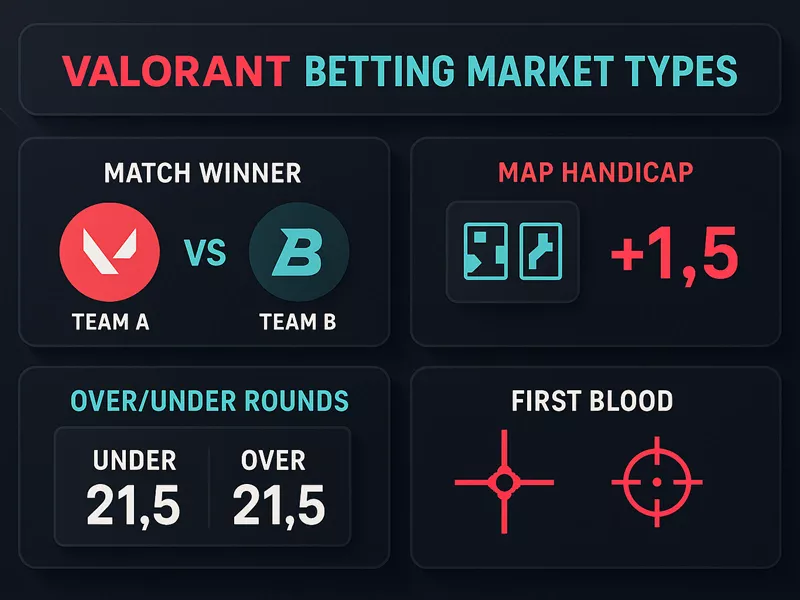
Overview of primary Valorant betting markets available at major sportsbooks
Match winner is where most people start. It's the simplest bet. Which team wins the best-of-three? If Sentinels are playing against a mid-tier team, Sentinels might be listed at -300 while their opponent is +240. These are American odds. Negative numbers show what you must bet to win one hundred dollars. Positive numbers show what you'd win if you bet one hundred dollars. So betting three hundred on Sentinels at -300 wins you one hundred in profit. Betting one hundred on the underdog at +240 wins you two hundred forty if they somehow pull the upset. Match winner bets settle based on the series result, not individual maps.
Map winner markets break things down further. In a best-of-three, you can bet on who wins map one specifically, map two, map three if it goes that far. This granularity helps when you believe a team might win the series but struggle on a particular map where their opponent specializes. If FNATIC is playing but the first map is Icebox where they're historically weak, betting against them on that specific map while still backing them for the series could make sense. Map winner odds adjust based on the map itself and each team's record on it.
Handicap betting adds or subtracts maps to a team's final count. A heavy favorite might be listed at -1.5 maps, meaning they need to win 2-0 for your bet to hit. If they win 2-1, you lose despite them winning the match. Conversely, the underdog at +1.5 maps wins your bet if they take even a single map, regardless of losing the series. Handicaps are useful when match winner odds are so lopsided that betting the favorite returns almost nothing. Instead of risking two hundred to win twenty on a massive favorite, bet them -1.5 maps at better odds though with more risk.
Understanding these markets is step one. Knowing which ones offer the best edges for your specific knowledge is step two. Match winners are efficient markets lots of betting action means bookmakers set tight lines. Props and niche markets tend to be softer because less money flows through them and bookmakers can't dedicate as much attention to pricing them perfectly. If you develop expertise in something specific like pistol round outcomes or agent selections, the prop markets might be where your edge lives.
Reading and Understanding Valorant Odds
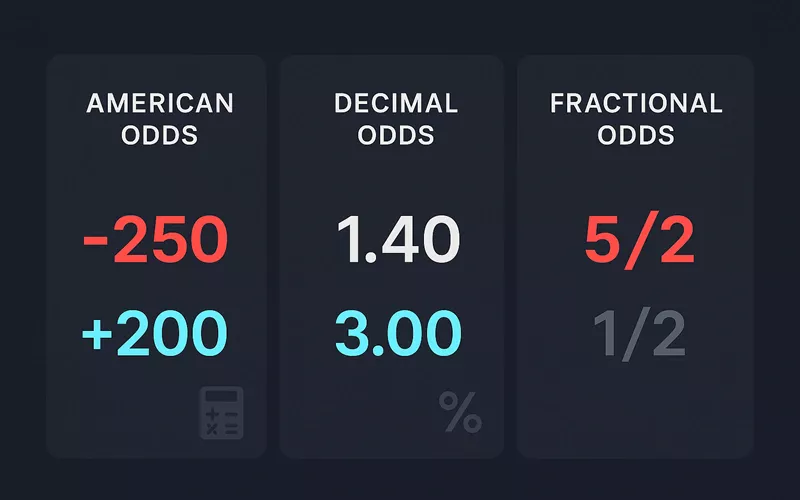
Understanding different odds formats: American, Decimal, and Fractional
Odds represent two things simultaneously. The bookmaker's assessment of probability, and the potential return on your wager. Mastering odds interpretation separates casual bettors from those who actually track their long-term profitability.
American odds use plus and minus signs. Negative odds indicate favorites how much you must risk to win one hundred dollars. Positive odds show underdogs how much you'd win if you risk one hundred dollars. Sentinels at -250 means bet two hundred fifty to win one hundred. The underdog at +200 means bet one hundred to win two hundred. These odds imply probability. To convert negative odds to implied probability, divide the odds by themselves plus one hundred, then multiply by one hundred. So -250 becomes 250 divided by 350, equals roughly 71.4%. The bookmaker thinks Sentinels have a 71% chance of winning.
Decimal odds are simpler arithmetically. Just multiply your stake by the decimal to calculate total return including your stake. Odds of 2.50 mean bet one hundred, get back two hundred fifty. Decimal 1.40 means bet one hundred, get back one hundred forty. Converting to implied probability is even easier divide one hundred by the decimal odds. So 2.50 becomes one hundred divided by 2.50, equals 40%. Decimal odds are popular in Europe and increasingly common globally because they eliminate the confusion around positive and negative American odds.
Fractional odds are traditional UK format. Odds of 5/2 mean you win five units for every two units risked, plus your stake back. Bet two hundred at 5/2, win five hundred profit plus your original two hundred for seven hundred total. Fractional odds persist mostly out of tradition. They're being phased out in favor of decimals even in the UK, but you'll still see them occasionally. Converting to implied probability requires dividing the denominator by the sum of both numbers and multiplying by one hundred. With 5/2, that's two divided by seven, equals roughly 28.5%.
Implied probability across all possible outcomes always exceeds one hundred percent. This excess is the vig, juice, or margin the bookmaker's built-in profit. If a match has Team A at -110 and Team B at -110, both convert to roughly 52.4% implied probability. Added together, that's 104.8%. The extra 4.8% is the margin. You're not betting at true odds. You're betting at odds adjusted to guarantee the bookmaker profits regardless of outcome, assuming balanced action on both sides.
The relationship between odds and probability isn't intuitive at first. A team at +300 sounds like they have no chance, but that's 25% implied probability they're expected to win once every four attempts. Over-relying on favorites because they feel safer is a common trap. Favorites lose all the time. If you need them to win 70% to break even based on the odds, and they actually only win 65%, you're bleeding money despite mostly backing winners. The odds are everything. Winning bets that aren't profitable at the given odds is a slow death for your bankroll.
Expected value is the core concept tying this together. If you bet one hundred dollars at +200 odds on something you believe has a 40% chance of happening, your expected value is positive forty dollars. Forty percent of the time you win three hundred, sixty percent you lose one hundred. That's 0.4 times 300 minus 0.6 times 100 equals eighty dollars average return on one hundred risked. You won't see that on any individual bet, but over enough trials, the math plays out. Positive expected value bets are the only bets worth making. Everything else is entertainment spending dressed up as investing.
Understanding odds deeply changes how you evaluate betting opportunities. It stops being about who you think will win and becomes about whether the price is right for your assessed probability. That shift in mindset is what separates long-term winners from everyone else.
Step-by-Step Guide to Placing Your First Bet
Walking through the process eliminates the anxiety that stops people from starting. I'll use a hypothetical VCT Americas match as our example Cloud9 versus LOUD, best-of-three.
First, you need an account at a legitimate betting site. For this example, let's say you chose GG.Bet because they have strong Valorant coverage and accept crypto. Navigate to their website, find the registration button, usually top-right corner. Enter your email, create a password, accept the terms. They'll send a verification email. Click the link, your account is active.
Now you need funds in the account. Go to the deposit page. Select your preferred method credit card, cryptocurrency, e-wallet. Let's say you're using Bitcoin. They provide a deposit address and QR code. Copy the address, open your crypto wallet, send the amount you want to deposit. Common starting amount is one hundred to two hundred dollars enough to place multiple bets without risking significant money while learning. The Bitcoin transaction confirms within thirty to sixty minutes depending on network traffic. Your account balance updates once confirmed.
Navigate to the Valorant section. On GG.Bet, this might be under esports, then filtering for Valorant specifically, or searching for upcoming matches. You see Cloud9 versus LOUD listed for tomorrow at 18:00 UTC. Click the match to expand available markets.
Now analyze the matchup. Cloud9 is listed at -165, LOUD at +140. This means Cloud9 are moderate favorites. The odds imply roughly 62% chance for Cloud9, 38% for LOUD after accounting for margin. Do your research. How have these teams performed recently? On which maps? Are there roster changes? Check VLR.gg for head-to-head history. LOUD recently beat Cloud9 2-1 in a close series two weeks ago. Cloud9 looked shaky against mid-tier opponents last week. This context matters.
Let's say after research, you believe LOUD is undervalued. The match is closer to 50-50 than 62-38. Betting LOUD at +140 offers value. Click the +140 odds for LOUD. Your betting slip populates on the right side of the screen with LOUD to win at +140. Enter your stake in the amount field. You decide on twenty dollars, 10% of your two hundred dollar bankroll. The slip automatically calculates potential return your twenty dollars plus twenty-eight dollars profit if LOUD wins, for forty-eight dollars total return.
Double-check everything before confirming. Right matchup? Right bet type? Correct stake amount? Easy to accidentally click the wrong team or mistype a stake. Once satisfied, hit the confirm or place bet button. The site processes the wager, deducts twenty dollars from your balance, and adds the bet to your active bets section.
Now you wait for the match. Day of, the match starts. You can either watch on Twitch where VCT Americas streams or check live scores on VLR.gg or similar sites if you're busy. LOUD takes the first map 13-9. Your odds of winning the bet just improved significantly. Cloud9 fights back on map two, winning 13-11. It goes to map three, the decider. LOUD closes it out 13-8. You won your bet.
Start small. Can't emphasize this enough. Your first month of betting should be about learning the rhythm, understanding how odds move, recognizing which matchups you can analyze effectively and which are basically coin flips. Losing fifty dollars while learning these lessons is cheap tuition. Losing five hundred because you came in overconfident is expensive and probably means you quit before actually gaining competence.
Track every bet in a spreadsheet. Date, matchup, bet type, odds, stake, result, profit or loss. After twenty or thirty bets, patterns emerge. Maybe you're profitable on underdogs but lose backing favorites. Maybe certain regions or maps are your blind spots. You can't improve what you don't measure. Excel or Google Sheets works fine. Track it religiously.
Advanced Valorant Betting Strategies
Moving beyond basic match winner bets opens up more sophisticated approaches. These strategies require deeper game knowledge and more analytical work, but they're where consistent profits hide if they exist at all.
Map pool analysis is fundamental. Every team has maps they prefer and maps they avoid. Paper Rex is historically dominant on Bind but shakier on Icebox. If they're playing a series where Bind is in the pool and makes it through the veto process, their chances of taking at least one map jump significantly. Conversely, force them onto their weak maps and even inferior teams have fighting chances. Checking recent map performances on sites like VLR.gg takes minutes but provides massive edge. The betting public often just looks at overall team strength without considering map-specific dynamics.
Regional style differences matter more than casual bettors realize. VCT Americas tends toward aggressive, aim-heavy gameplay with more puggy takes. EMEA favors disciplined strategy and utility usage. Pacific plays a controlled default style that explodes into chaos when they commit. China is still developing its identity but often shows brilliant individual mechanics with less refined team coordination. When regions clash at international events, the style matchups create edges. An EMEA team might destroy Americas opponents who over-peek into their crosshairs, but struggle against Pacific teams that avoid those aim duels entirely.
Avoiding recency bias is paradoxically both a strategy and a discipline. Everyone overweights recent results. Team wins three straight, they're suddenly world-beaters. They lose three straight, they're washed. Reality is usually more stable. A team that's been top-five for a year and just lost three close matches is probably still good and due for regression to their mean. Betting against recency-biased public perception creates value.
These strategies aren't guarantees. The house edge exists. Information asymmetry is minimal in 2026 compared to early days of esports betting. But edges still exist in disciplined research, faster analysis of new information, and exploiting the gaps between your probability assessment and the bookmaker's implied odds. String together enough small edges, manage your bankroll properly, and you can realistically stay profitable or at least minimize losses while enjoying the entertainment.
Bankroll Management for Valorant Betting
All the analysis in the world means nothing if you go broke betting too much on any single match. Bankroll management is the unglamorous foundation that determines whether you're still betting six months from now or busted out after a bad week.
Your bankroll is the total amount you've set aside specifically for betting. Not rent money. Not emergency savings. Money you can afford to lose entirely without impacting your life. For most people starting out, this is somewhere between one hundred to five hundred dollars. Whatever the number, treat it as a separate account mentally and ideally literally. Once that money is gone, you're done until you save more. No chasing with funds from elsewhere.
Unit sizing is how much you bet per wager. Standard recommendation is one to three percent of your bankroll per bet. If you have two hundred dollars, one unit is two to six dollars. Betting ten or twenty dollars per match when you've only got two hundred total is asking for variance to ruin you. You might win five in a row and feel like a genius. Then you hit a normal losing streak six losses in eight bets and you're down to thirty dollars and panicking. Proper unit sizing ensures you can withstand inevitable losing streaks without going bust.
Separating betting money from winnings is another useful trick. Start with two hundred dollars. Run it up to three hundred. Pull out your initial two hundred and bet only with the one hundred profit. Now you're playing with house money. Even if you lose it all, you break even overall. This makes it easier to take calculated risks without feeling like you're gambling away your own funds. Whether this is rational or just psychological trickery doesn't matter if it keeps you betting smart, use it.
Valorant betting is a marathon, not a sprint. Success measures across hundreds of bets over months and years. Bankroll management ensures you're still around to see if your edge is real or imagined. Most people skip this boring part, chase short-term results, blow up their roll, and quit. Don't be most people.
Key Tournaments and Events to Bet On
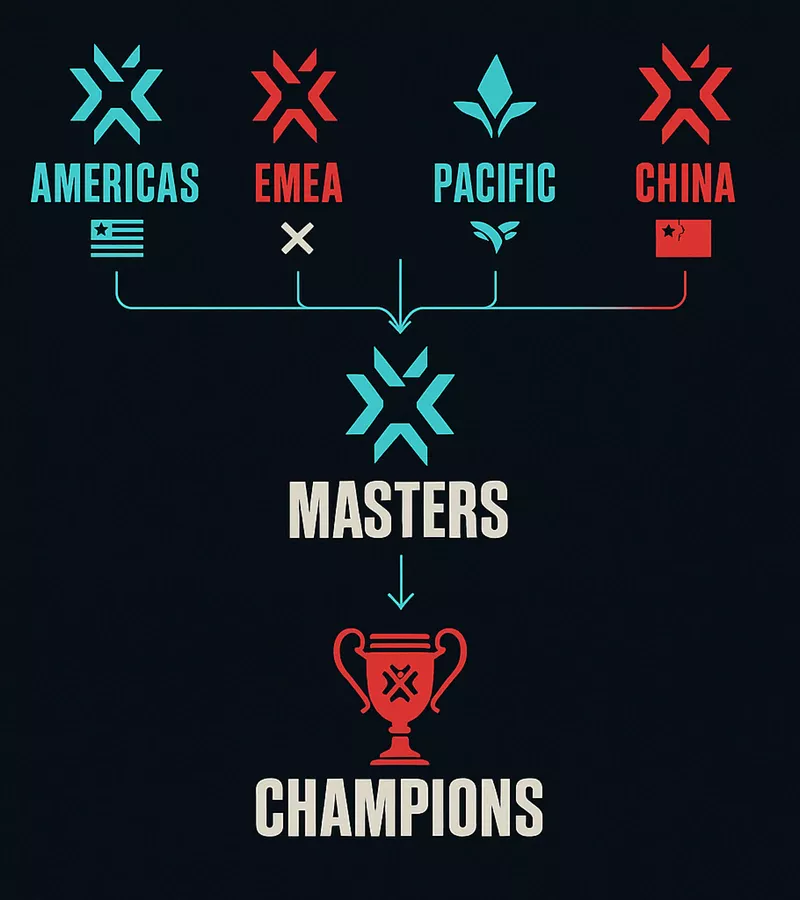
Valorant Champions Tour structure: from regional leagues to world championship
Valorant's competitive calendar revolves around the Valorant Champions Tour, Riot's official ecosystem. Understanding the tournament structure helps you identify the best betting opportunities throughout the year.
VCT operates across four regions Americas, EMEA, Pacific, and China. Each region runs its own International League, basically a regional league where twelve partnered teams play regular season matches. This is the bread and butter of Valorant betting. Nearly every week from February through May, you've got matches across all four regions. Consistency of matches means consistent betting opportunities and more data to analyze team form.
The format changed significantly in 2023 when Riot implemented the partnership model. Before, tournaments were open with teams qualifying through various routes. Now, specific organizations hold permanent league spots. This created stability you're not dealing with random teams appearing and disappearing constantly. Same core rosters play week after week, making analysis more reliable.
Valorant Champions is the annual world championship, typically held in August or September. Sixteen teams qualify through their international league performance and Masters results. This is the biggest event of the year with the highest prize pool and stakes. Matches are almost all best-of-three until playoffs go best-of-five. Champions is where momentum and experience under pressure matter most. Some teams crumble on the big stage. Others elevate beyond their regular season level. Historical performance at Champions becomes relevant when making outright bets.
VCT Ascension tournaments run parallel to the main VCT. These are second-tier competitions where teams fight for promotion into the International Leagues. If you're deeply into a specific region's tier-two scene, Ascension offers betting markets that the general public ignores, potentially creating edges. However, the information available on these teams is thinner, and upsets happen more frequently because skill gaps are smaller.
The Valorant competitive calendar provides nearly year-round betting opportunities. Learning the rhythm of when teams are try-harding versus coasting, when the meta is stable versus in flux, and which tournaments offer the most information for analysis separates people who are serious from those who bet randomly whenever they happen to watch a match.
Common Mistakes Bettors Make and How to Avoid Them
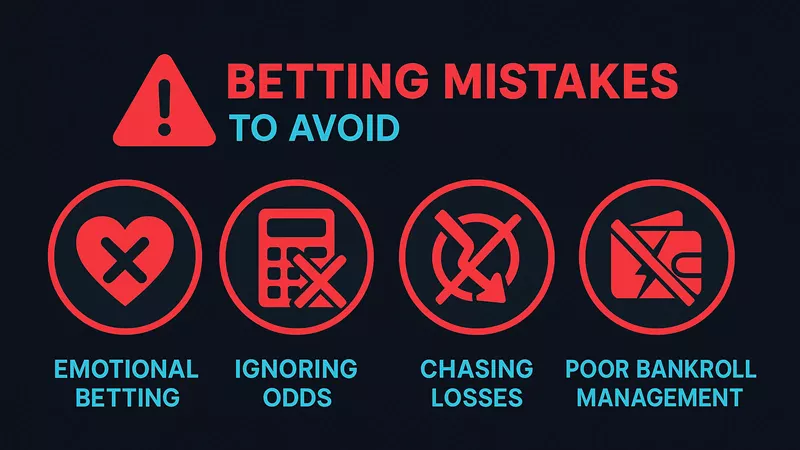
Avoid these critical betting mistakes to protect your bankroll
Learning from others' failures is cheaper than experiencing all of them yourself. These mistakes kill bankrolls consistently across esports betting.
Betting with your heart instead of head is the most common trap. You're a Cloud9 fan. You've watched them since 2021. TenZ is your favorite player. Cloud9 is playing against Paper Rex, and you ignore the fact that Paper Rex has beaten them four straight times. You bet Cloud9 because you want them to win, not because the odds offer value. This is entertainment, not investing. If you want to bet on your favorite team regardless of analysis, fine just acknowledge you're paying for emotional investment and don't expect to profit.
Not shopping for odds costs you money constantly. You bet exclusively on GG.Bet because that's where you registered first. You don't check that Pinnacle offers -145 while GG.Bet has -160 on the same bet. Over fifty bets, the accumulated difference from better odds is the equivalent of winning one or two extra bets outright. Use odds comparison tools or maintain accounts at three or four bookmakers and always take the best available price.
Overlooking meta changes loses bets you should win. Patch drops three days before a tournament, nerfing two agents heavily. You bet on Team A whose strategy centers on those agents. They haven't adapted yet. They get crushed. You're confused because they're the better team on paper. On paper, sure on last patch. Reading patch notes and following how teams adjust is required work if you want edges.
Betting on unfamiliar regions is playing blind. You've watched every VCT Americas match but barely seen VCT China games. Chinese teams are playing and you bet based on name recognition or just picking favorites. The playstyle, team dynamics, and form in that region are completely foreign to you. Your analysis is worthless. Stick to what you know. Better to skip bets than to make uninformed wagers.
Ignoring map vetoes in map-specific betting is leaving money on the table. You bet Team A to win map one. You didn't check that map one is Icebox, which Team A is 2-8 on this season while their opponent is 9-3. The veto process determines which maps get played. If you're betting individual maps without checking what those maps are and each team's record on them, you're just guessing.
Overvaluing recent performance is recency bias. Team wins three straight and suddenly they're unbeatable in your mind. You ignore that the wins were against bottom-tier opponents and they barely scraped by in all three. Now they're facing a top team, and your inflated perception from the recent wins makes you overconfident in their chances. Recent form matters, but context matters more. Three wins against trash teams means nothing.
These mistakes are avoidable with discipline and awareness. Most bettors make at least half of them regularly. Recognizing these patterns in yourself and actively working to eliminate them is probably more valuable than any advanced strategy. Don't be your own worst enemy.
Valorant betting 2026: key takeaways, safer approach, and next steps
Valorant betting in 2026 offers legitimate opportunities if approached with the right mindset and methods. You've learned the game's competitive structure, how betting markets function, the mechanics of odds and value, and the discipline required to manage bankrolls effectively. The distance between knowledge and profitable betting is execution.
Start small. Bet within your means using proper unit sizing. Track every wager in a spreadsheet so you can honestly assess whether you're finding real edges or just getting lucky short-term. Focus on markets and regions where your knowledge is deepest rather than spreading yourself thin trying to bet everything.
Valorant esports is growing. The betting markets are maturing but still offer inefficiencies for those willing to work for them. Five years from now, the edges will be thinner as more sharp money enters and bookmakers get better at pricing. The opportunity is now for those who put in the effort.
Bet smart. Bet responsibly. Welcome to Valorant betting.
