
 Available in US
Valorant Betting Odds Explained: How to Read, Compare & Find Value
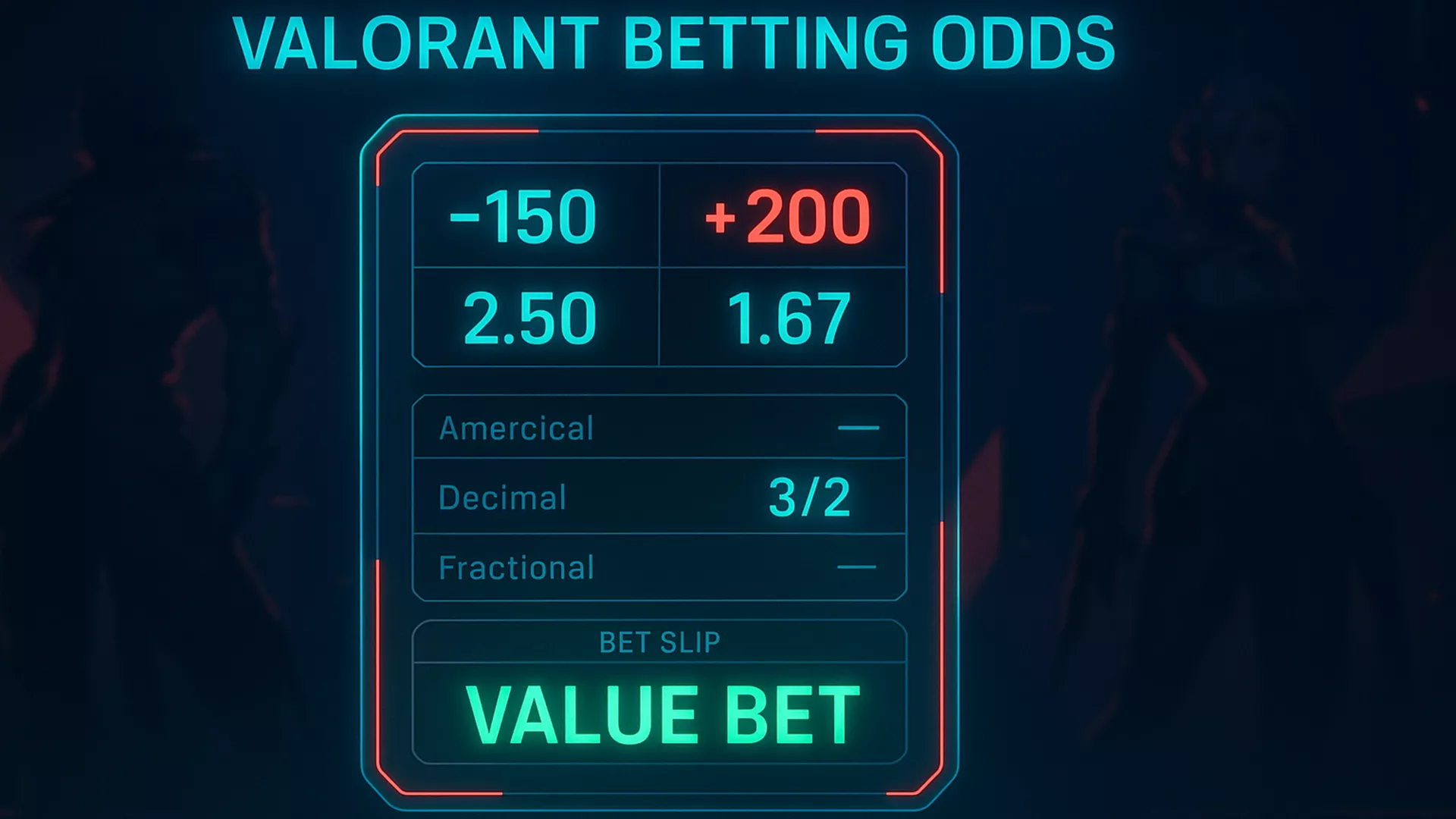
Odds are the language of betting. If you don’t understand them fluently, you’re essentially betting blind regardless of how much you know about Valorant. I’ve watched people with encyclopedic knowledge of VCT teams, perfect recall of head-to-head records, and deep understanding of map pools still lose money consistently because they never learned to properly evaluate whether a betting line offered value.
The math isn’t complicated. Middle school arithmetic covers everything you need. What trips people up isn’t the calculation it’s understanding what odds actually represent and how to use them for decision-making. Odds tell you two critical things simultaneously: the bookmaker’s assessment of probability, and your potential return if you win. Mastering the relationship between these concepts transforms betting from guessing which team wins to identifying when the price makes a bet worth taking.
This guide breaks down everything about Valorant betting odds that actually matters. How the three main formats work, what implied probability means and why it’s more important than the odds themselves, how bookmakers set lines and where inefficiencies hide, finding value bets versus just picking winners, and the practical skills for comparing odds across multiple bookmakers to maximize returns. Whether you’re placing your first Valorant bet or you’ve been betting for months without really understanding the numbers, there’s something here that’ll make the concept click.
The Three Odds Formats Explained
Bookmakers display odds in three primary formats depending on their target market. American odds dominate in the United States, decimal odds are standard across Europe and much of the world, and fractional odds persist in the UK despite slowly being phased out. Understanding all three formats helps when comparing odds across different betting sites.
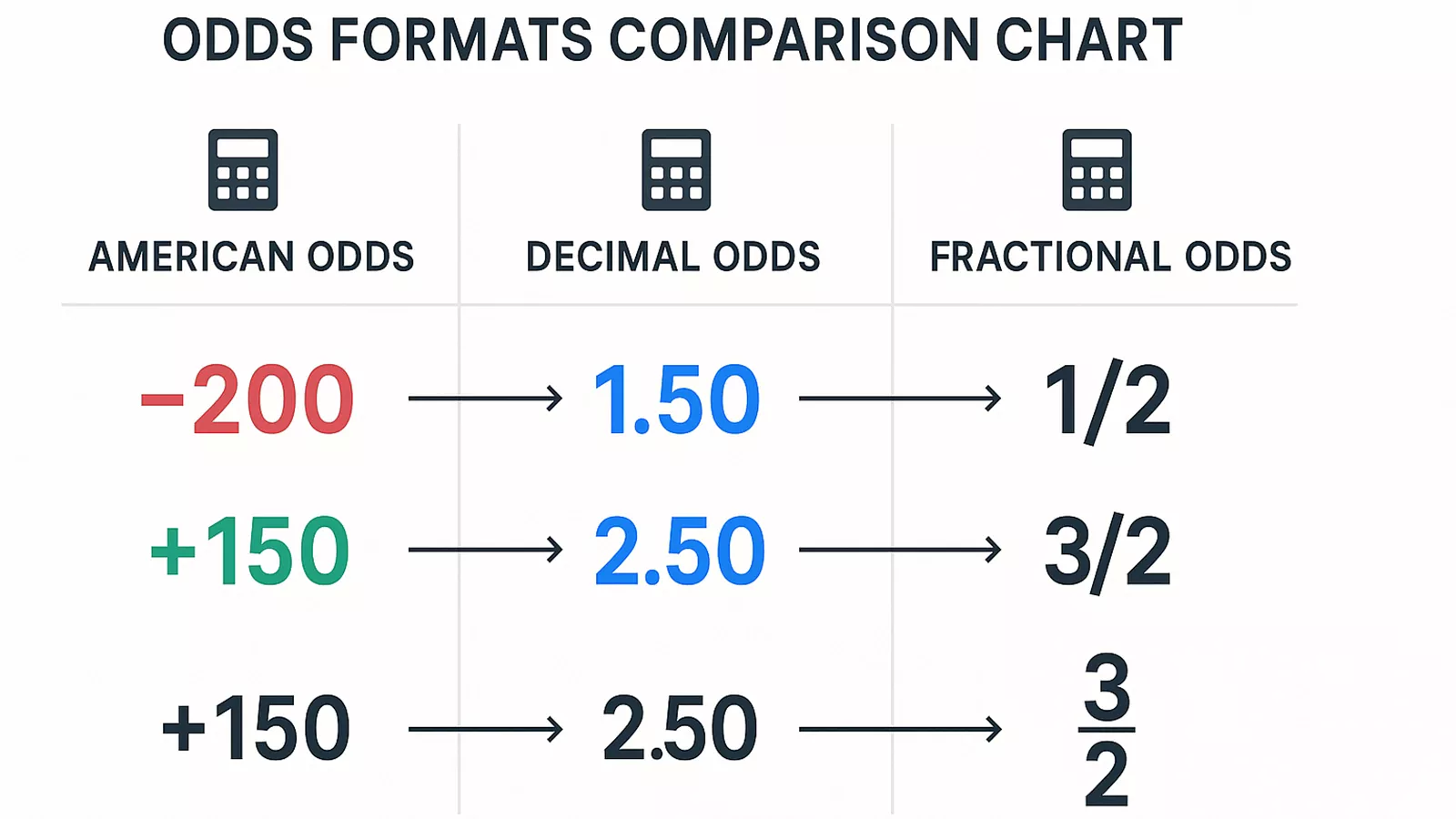
American odds use positive and negative numbers to indicate underdogs and favorites. When you see a team at -200, that negative number tells you they’re favored to win. The number specifically shows how much you must risk to win one hundred dollars in profit. Betting two hundred on a -200 favorite wins you one hundred dollars profit plus your two hundred dollar stake back for three hundred total return.
When you see a team at +150, that positive number indicates they’re the underdog. The number shows how much profit you’d make if you risked one hundred dollars. Betting one hundred on a +150 underdog wins you one hundred fifty dollars profit plus your original one hundred back for two hundred fifty total return.
The math works proportionally at any stake level. Betting fifty dollars at -200 wins you twenty-five dollars profit. Betting twenty dollars at +150 wins you thirty dollars profit. The calculation is simple division divide your stake by two for -200 odds because you’re risking two hundred to win one hundred. Multiply your stake by 1.5 for +150 odds because you’re winning one hundred fifty per hundred risked.
American odds at exactly -110 or -105 are common on relatively even matchups. These numbers indicate the bookmaker sees the teams as close to equal with a slight edge to one side. The -110 means risk one hundred ten to win one hundred in profit, which translates to roughly 52.4% implied probability. Understanding this conversion between odds and probability is where things get interesting and we’ll dig deeper shortly.
Decimal odds are mathematically simpler and increasingly popular even outside Europe. The decimal number shows your total return for every one unit wagered, including your original stake. Odds of 2.50 mean bet one hundred, get back two hundred fifty total your one hundred stake plus one hundred fifty profit.
Converting decimal odds to potential returns requires only multiplication. Take your stake, multiply by the decimal, and the result is your total return if you win. Betting seventy-five dollars at 3.20 decimal odds returns two hundred forty dollars total that’s seventy-five times 3.20. Your profit is one hundred sixty-five after subtracting your original seventy-five stake.
Decimal odds below 2.00 indicate favorites. Odds of 1.50 mean you’re risking more than you can win because your total return is only 1.5 times your stake. Decimal odds above 2.00 indicate underdogs where you’re winning more than you risk. Exactly 2.00 is equivalent to American +100, representing even money where you risk one hundred to win one hundred.
The appeal of decimal odds is transparency. You can instantly see total returns without mental math about whether odds are positive or negative and what that means for profit calculations. For most bettors, decimal odds are the most intuitive format once you get used to thinking in terms of total return rather than profit.
Fractional odds display as ratios like 5/2 or 11/10. The first number shows potential profit, the second number shows required stake. Odds of 5/2 mean you win five units for every two units risked. Bet twenty dollars at 5/2, win fifty dollars profit plus your twenty back for seventy total return.
The calculation requires slightly more work than decimals. Take your stake, divide by the denominator, multiply by the numerator, and add your stake back. With forty dollars at 7/4 odds, you divide forty by four (equals ten), multiply by seven (equals seventy profit), add back your forty stake for one hundred ten total return.
Fractional odds are declining in popularity because they’re less intuitive than decimals for most people. Odds of 11/8 require calculation to determine potential return, while decimal 2.38 or American +138 give you immediate sense of value. The UK betting market is slowly transitioning toward decimals, though fractions persist out of tradition. Most modern betting sites let you toggle between formats in settings, so pick whichever makes sense to you.
Converting Between Formats
Being able to quickly convert between odds formats matters when comparing lines across multiple bookmakers. Site A lists a team at -125 American odds, Site B shows 1.80 decimals, Site C displays 4/5 fractional. Without conversion ability, you can’t identify which offers the best value.
Converting American to decimal uses different formulas for favorites versus underdogs. For negative American odds, divide one hundred by the odds, add one, and that’s your decimal. So -200 becomes one hundred divided by two hundred equals 0.5, plus one equals 1.50 decimal. For positive American odds, divide the odds by one hundred, add one, and that’s your decimal. So +150 becomes one hundred fifty divided by one hundred equals 1.5, plus one equals 2.50 decimal.
Converting decimal to American also splits into two paths. For decimals below 2.00 indicating favorites, subtract one, divide that into negative one hundred, and that’s your American odds. So 1.50 decimal becomes 1.50 minus one equals 0.5, negative one hundred divided by 0.5 equals -200 American. For decimals above 2.00 indicating underdogs, subtract one, multiply by one hundred, and that’s your American odds. So 2.50 decimal becomes 2.50 minus one equals 1.5, times one hundred equals +150 American.
Fractional to decimal is straightforward divide the numerator by denominator, add one. Odds of 5/2 becomes five divided by two equals 2.5, plus one equals 3.50 decimal. Decimal to fractional requires finding the ratio. Subtract one from decimal, convert to a fraction, and simplify. Decimal 2.50 becomes 2.50 minus one equals 1.5, which is 3/2 simplified.
Rather than memorizing formulas, most bettors use odds converter tools available free online. Punch in one format, instantly get the other two. This is completely fine and practical. What matters more than memorizing conversion math is understanding what the different formats represent conceptually so you can evaluate value regardless of which format a bookmaker displays.
Implied Probability and Why It Matters Most
Odds fundamentally represent probability assessments, not just potential returns. Understanding implied probability the probability an outcome must occur for a bet to break even long-term is the single most important concept for successful betting.
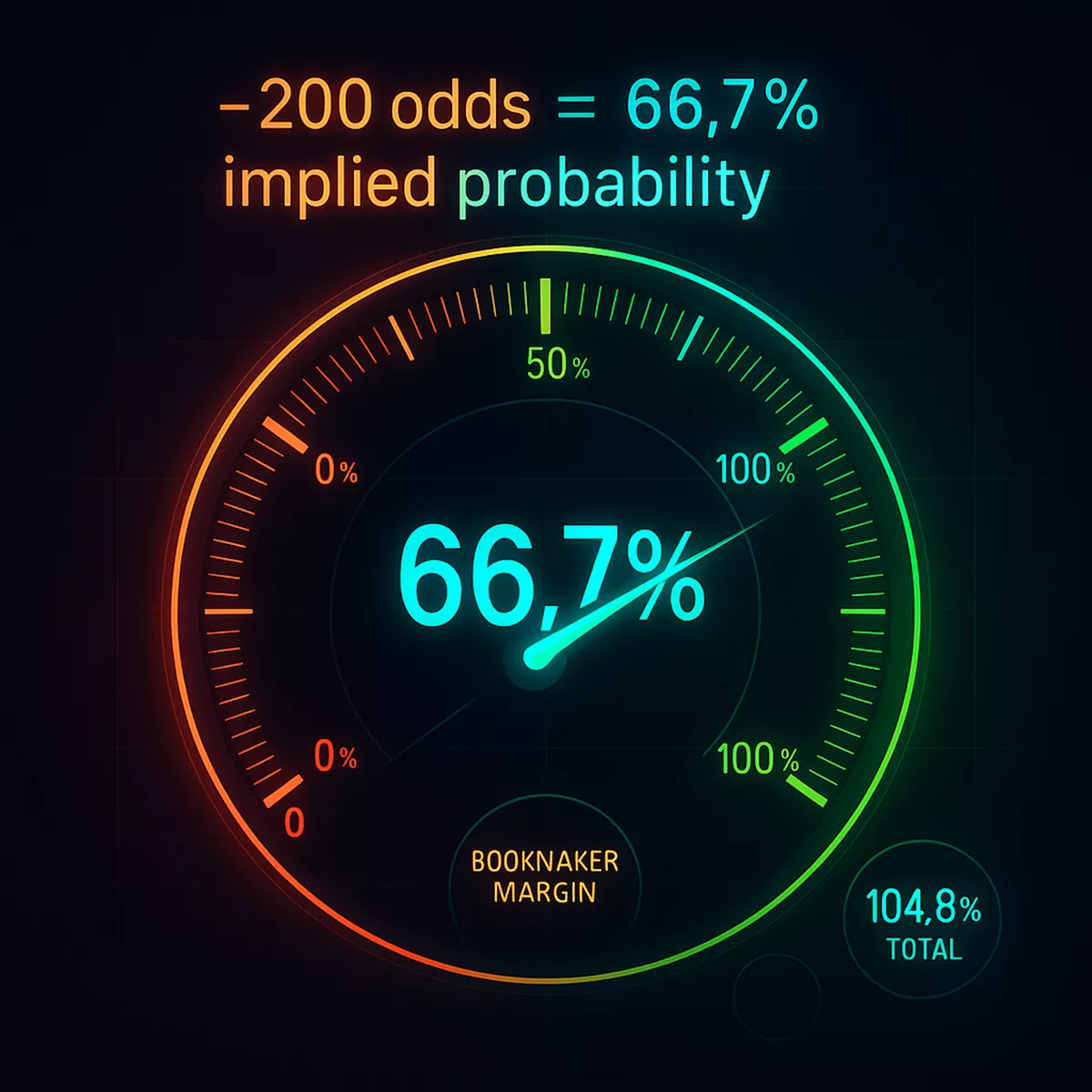
Converting American odds to implied probability follows specific formulas. For negative odds, divide the absolute value of the odds by that number plus one hundred, then multiply by one hundred for a percentage. So -200 becomes two hundred divided by three hundred, equals 0.667, times one hundred equals 66.7% implied probability. For positive odds, divide one hundred by the odds plus one hundred, then multiply by one hundred. So +150 becomes one hundred divided by two hundred fifty, equals 0.4, times one hundred equals 40% implied probability.
Converting decimal odds to implied probability is simpler. Just divide one hundred by the decimal odds. Decimal 2.50 becomes one hundred divided by 2.50 equals 40% implied probability. Decimal 1.50 becomes one hundred divided by 1.50 equals 66.7% implied probability. This mathematical simplicity is another reason decimal odds are increasingly popular.
The implied probabilities across all possible outcomes in a betting market always sum to more than one hundred percent. This excess is how bookmakers guarantee profit. Look at a Valorant match where Team A is -110 and Team B is -110. Both convert to 52.4% implied probability. Added together, that’s 104.8%. The extra 4.8% is the bookmaker’s margin, also called vig, juice, or overround.
This margin exists in every betting market and represents the house edge you’re fighting against. Some bookmakers have tighter margins than others. Pinnacle might offer a match where implied probabilities sum to 102%, while a less competitive bookmaker might have the same match summing to 108%. That six percentage point difference compounds dramatically over hundreds of bets. Betting at sites with lower margins is essentially getting a discount on every wager.
Understanding implied probability transforms how you evaluate bets. Instead of asking “which team will win,” you ask “is my assessment of win probability higher than the implied probability in the odds.” If you believe Team A has a 50% chance of winning but the odds give them 43% implied probability, that’s a value bet regardless of whether they actually win this specific match. Over many iterations of finding true 50% situations priced at 43%, you profit.
This probability-focused mindset is what separates long-term winners from losers. Plenty of bettors correctly pick winners at a 60% rate and still lose money because they’re betting favorites at prices where they need to win 70% to break even. Meanwhile, sharp bettors win at only 52% but profit consistently because they only bet when they have an edge in probability versus the implied odds.
How Bookmakers Actually Set Valorant Odds
Understanding the mechanics of how betting lines get created helps identify where inefficiencies exist and when odds might not accurately reflect true probabilities.
Bookmakers employ odds compilers who build statistical models to assess match probabilities. For Valorant, these models incorporate team Elo ratings, recent form, head-to-head records, map pool strengths, roster changes, and various other factors. The models spit out estimated probabilities for each possible outcome. These probabilities get converted to odds, then the bookmaker’s margin gets applied.
So if the model says Team A has a 55% chance of winning, the bookmaker might offer odds implying 58% probability after adding margin. They do the same for Team B if the model says 45% chance, they offer odds implying 48% probability. Now the implied probabilities sum to 106%, creating a six percent margin protecting the bookmaker from balanced action causing losses.
The initial lines posted by bookmakers are educated guesses based on their models. Once bettors start placing wagers, the lines move based on where money flows. If the bookmaker posts a match at -150/-150 trying to attract equal action both sides, but most money comes in on Team A, they’ll adjust Team A to -170 or -180 to discourage more bets there while moving Team B to +150 or +160 to attract money balancing the other side.
This line movement happens continuously until match time as bookmakers try to balance their liability. They want roughly equal money on both outcomes so they collect the margin regardless of who wins. If they have ten thousand dollars on Team A and ten thousand on Team B, they pay out ten thousand to winners, collect ten thousand from losers, and keep the margin built into odds as profit.
However, lines don’t move solely based on money volume. Bookmakers also respect “sharp” action from professional bettors known for consistently identifying value. If a respected sharp bettor places a large wager on Team B, the bookmaker might move Team B’s odds shorter even if total dollar volume came in on Team A. They trust that sharp money represents genuine information about true probabilities.
For Valorant specifically, bookmakers struggle most with niche markets and international matchups. Match winner odds on VCT Americas regular season get razor sharp because lots of betting volume and data exist. Odds on a tier-two Chinese qualifier match might be soft because the bookmaker’s model has limited data and few bettors are knowledgeable enough to identify misprices. Similarly, when EMEA teams face Pacific teams for the first time in months at Masters, the bookmaker’s model lacks recent head-to-head data to calibrate probabilities accurately.
Finding Value Bets in Valorant Markets
Value betting means identifying situations where your assessment of probability is more favorable than the implied probability in the odds. This is the only way to profit long-term from betting.
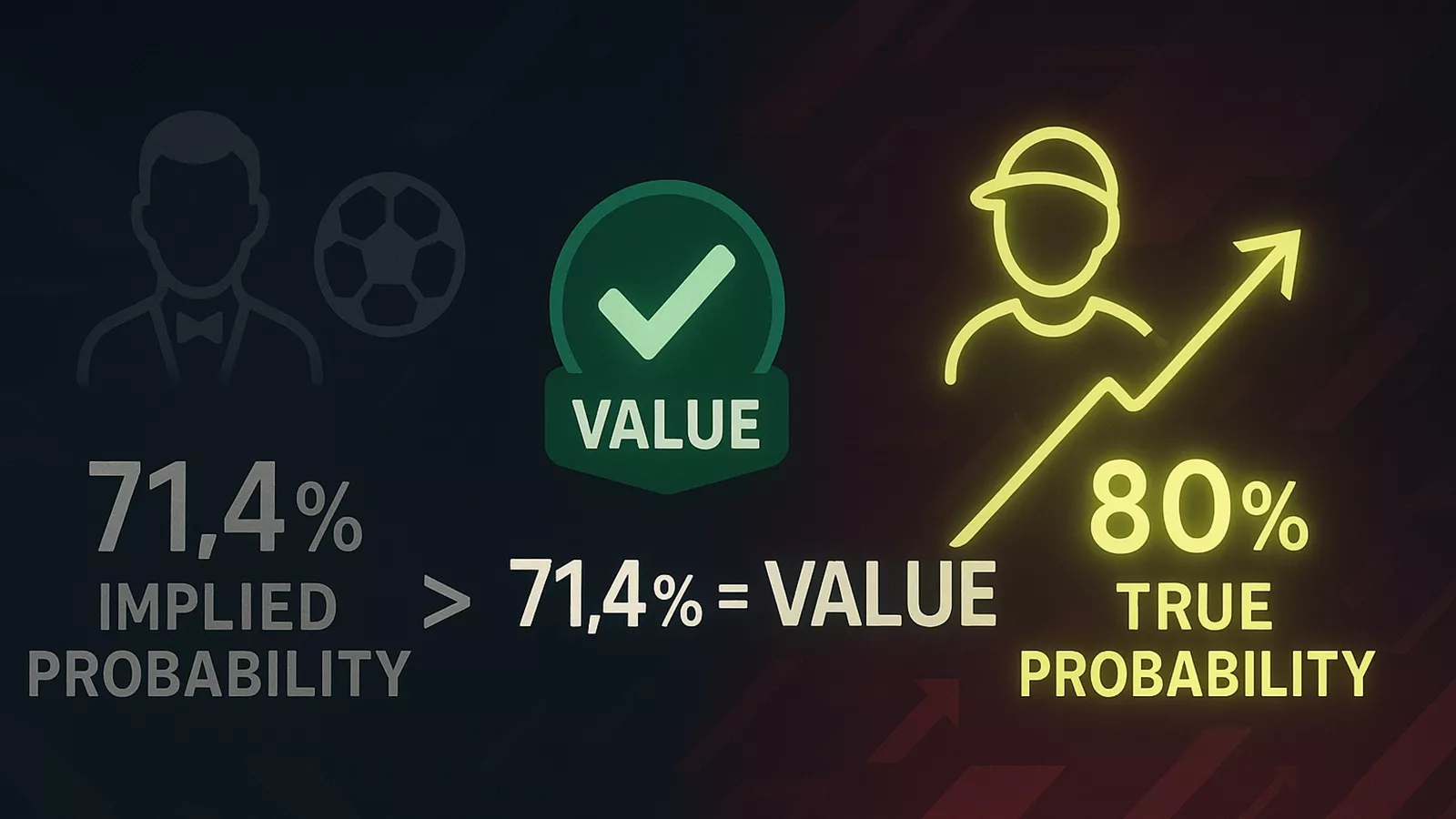
Let’s use a concrete example. Sentinels are playing against a mid-tier team. The bookmaker offers Sentinels at -250, which implies 71.4% probability of winning. You’ve watched both teams extensively and believe Sentinels actually have an 80% chance of winning based on roster strength, recent form, and map pool matchups. The difference between your 80% assessment and the 71.4% implied probability represents value.
Should you bet this? Maybe. The raw value exists, but you also need to consider bet sizing, your confidence level in the 80% assessment, and whether your edge is large enough to overcome variance. But fundamentally, this is a value situation because you believe the true probability exceeds the implied probability.
Contrast this with betting Sentinels as a -500 favorite, implying 83.3% probability. Even if you think they’re 80% to win, you have negative expected value. You’re betting on a favorite at a price where they need to win more often than you believe they actually will. These are the bets that slowly drain bankrolls despite mostly winning because the wins don’t pay enough to offset the occasional loss.
Value also exists in comparative terms. Maybe you don’t have strong opinion on who wins Sentinels versus this mid-tier team. But checking multiple bookmakers, you find GG.Bet offers Sentinels at -220 while Pinnacle has them at -250. All else equal, betting at -220 provides better value because you’re getting better implied probability and return. This is “line shopping” and it’s essential for maximizing profits.
The key insight is this: betting isn’t about picking winners, it’s about finding prices. You can correctly pick the winner 70% of the time and lose money if you’re consistently betting favorites at prices requiring 75% win rate to profit. Conversely, you can pick winners only 45% of the time and profit if you’re consistently betting underdogs at prices only requiring 40% to break even.
Expected value calculation formalizes this. If you bet one hundred dollars at +200 odds on something you assess at 40% probability, your expected value is positive. Forty percent of the time you win three hundred total, sixty percent you lose one hundred. That’s 0.4 times three hundred minus 0.6 times one hundred equals one hundred twenty minus sixty equals positive sixty expected value. You’re expected to profit sixty dollars on average per one hundred wagered when you repeatedly find true 40% situations priced at +200 or better.
This mathematical approach to betting removes emotion and focuses on process. Any single bet can lose variance guarantees that. But if you consistently make positive expected value bets, the math works in your favor over hundreds of wagers. Focus on finding value, not on agonizing over individual results.
Odds Movement and What It Tells You
Watching how odds change between initial posting and match start provides information about where smart money is going and what the efficient price might actually be.
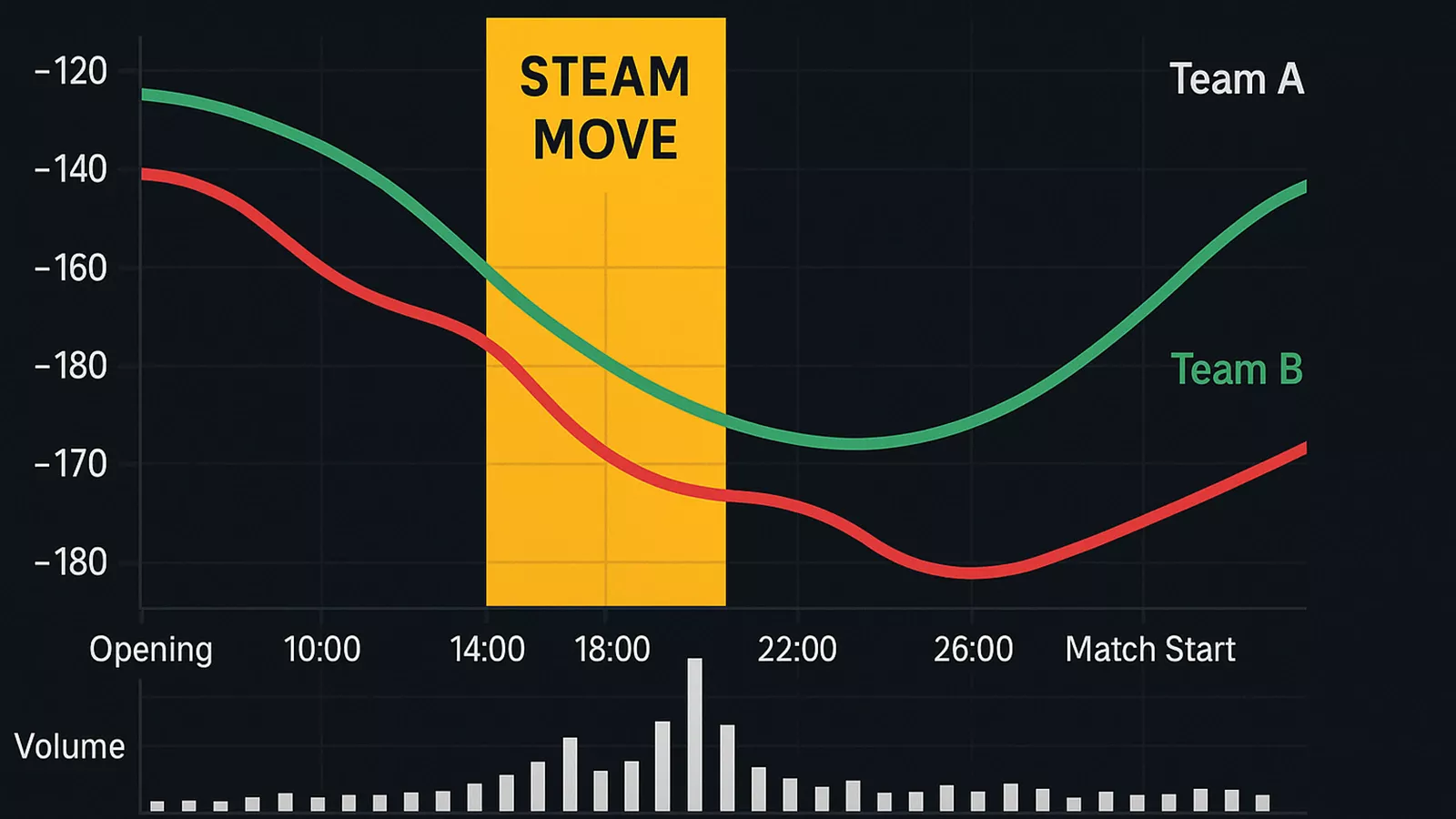
When a Valorant match first gets listed, the bookmaker posts opening odds based on their model. These opening lines are pure bookmaker assessment before any betting action influences the numbers. If you believe you have better information than the bookmaker’s model, opening lines offer maximum value opportunity.
Steam moves are extreme examples where odds shift dramatically in minutes. Maybe Team A goes from -140 to -170 in a five-minute span. This indicates multiple sharp bettors or betting syndicates hammering Team A simultaneously, and the bookmaker is adjusting aggressively to manage risk. Steam moves often indicate legitimate information roster changes, injury news, or insider knowledge about team preparation that hasn’t become public yet.
Reverse line movement is particularly interesting. This happens when odds move opposite to the betting volume. Imagine eighty percent of bets are on Team A but Team A’s odds get worse while Team B’s odds improve. This means the bookmaker respects the sharp money on Team B despite majority betting volume on Team A. The smart money is on Team B, and you should pay attention.
Tracking line movement requires monitoring odds at multiple bookmakers because different sites have different customer bases and respect different sharp bettors. A line might move at Pinnacle but stay stable at GG.Bet, suggesting the sharp action is concentrated at Pinnacle. Shopping odds across sites helps identify these discrepancies and lets you bet at sites that haven’t adjusted yet.
For Valorant specifically, line movement tends to be less dramatic than traditional sports because betting volumes are smaller. But the same principles apply. Watching how VCT match odds evolve from opening to close gives you sense of where informed money is going. If you’re betting against consistent line movement, you better have strong reasons for going contrarian.
Comparing Valorant Odds Across Bookmakers
Different bookmakers offer different odds on the same Valorant matches. Shopping for the best available price is one of the easiest ways to improve your betting ROI without doing any additional analysis.
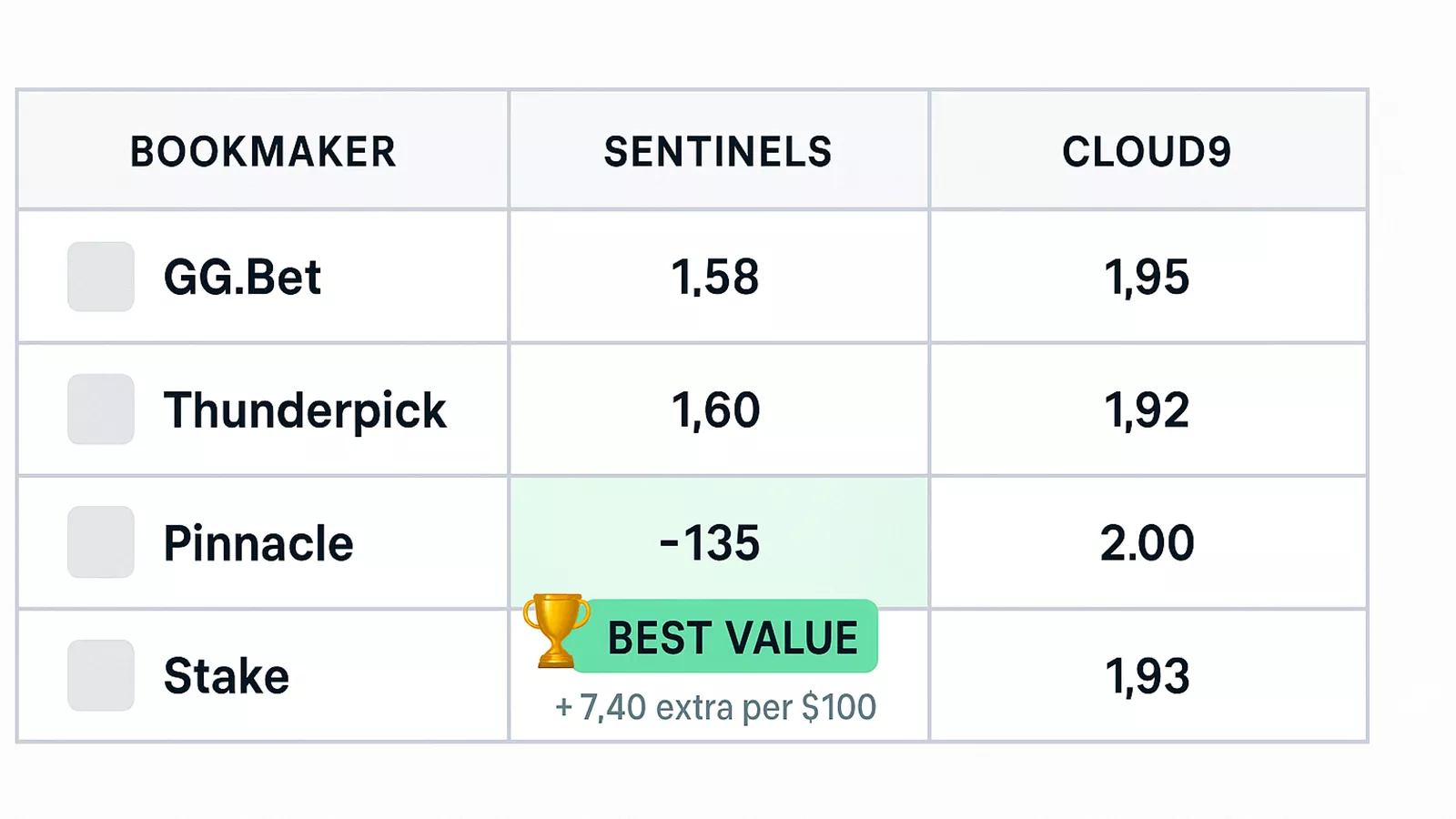
Consider a Sentinels versus Cloud9 match. GG.Bet might offer Sentinels at -150, Thunderpick has them at -145, and Pinnacle posts -135. All else equal, you want to bet at Pinnacle because -135 gives you better expected return than -150. The difference seems small on one bet, but compound this over hundreds of wagers and you’re talking about thousands of dollars left on the table by not shopping odds.
The math on this is straightforward. Betting one hundred dollars at -150 wins 66.67 profit. Betting one hundred dollars at -135 wins 74.07 profit. That’s 7.40 extra profit on every hundred dollars wagered simply by using a different bookmaker. Make fifty bets at one hundred dollars each, and you’ve gained 370 dollars just from line shopping.
Different bet types might be best at different bookmakers for the same match. Maybe Pinnacle has the best match winner odds but GG.Bet has better map handicap odds. Maybe Stake has better over-under on total maps. Shopping odds isn’t just about match winners apply the same process to every market you bet. The best bookmaker for one bet type isn’t necessarily best for others.
Live Betting Odds and Real-Time Value
Live betting creates unique opportunities because odds update constantly during matches based on score and game state. Understanding how live odds work differently than pre-match odds helps identify value.
Pre-match odds are set once and don’t change after the match starts. You’re betting based on all information available before action begins. Live odds continuously adjust throughout the match as events unfold. Team wins the first map of a best-of-three, their odds to win the series shorten dramatically. Team goes down 0-5 on a map, their odds to win that map balloon.
The key to live betting value is recognizing when odds overreact to recent events or lag behind actual game state. A team loses pistol round and immediately goes down 0-3, their map winner odds might lengthen to +200 or more. But you know that pistol round losses aren’t predictive of map losses teams regularly come back from 0-3 or worse. If nothing else about the matchup changed, the inflated odds on a team down 0-3 might offer value.
The best live betting opportunities come from specific game knowledge that casual bettors lack. Understanding which maps are attacker versus defender-sided, which agents have impactful ultimate abilities in specific round types, how different site executes work this expertise lets you assess true win probabilities in real-time better than bookmakers who are mostly reacting to score changes.
Practical Odds Analysis for Different Bet Types
Different betting markets have different odds characteristics and require different analytical approaches to identify value.
Match winner odds are the most efficient because they see the highest betting volume and most analytical attention. Finding consistent value betting match winners requires either superior information about teams or identifying spots where public bias pushes odds away from true probabilities. Maybe the public overvalues a popular team with lots of fans, creating value on their opponent. Maybe a roster change that dramatically weakened a team hasn’t been fully priced in yet.
Prop bets like first kill, pistol round winners, and player performance bets are typically very soft markets. Bookmakers don’t invest resources pricing these precisely because volume is low. If you develop specific expertise maybe you study pistol round strategies intensely and know which teams excel there you can consistently find value in these niche markets that doesn’t exist in main markets.
Outright tournament winner odds at the start of an event are often inefficient because the tournament hasn’t started and predicting week-long performance is difficult. Early tournament odds might undervalue teams with strong upset potential or overvalue favorites that will crumble under pressure. These outrights are lottery tickets for most bettors, but with careful analysis, you can identify teams whose true chances significantly exceed their implied odds probability.
The Mental Game of Odds Evaluation
Understanding odds mathematically is necessary but not sufficient. The psychological aspects of evaluating and acting on odds information matter just as much for long-term success.
Overconfidence in your ability to beat odds is the most common mental trap. You identify what seems like obvious value, bet heavily, lose, and rationalize it as variance while immediately finding the next “obvious” value bet. Maybe your edge isn’t as large as you think. Maybe you’re not properly accounting for uncertainty in your probability assessments. Staying humble about the limits of your analysis prevents overextending on perceived value that doesn’t actually exist.
Maintain a betting journal documenting every wager. Not just results but your reasoning. What did you assess the true probability as? What were the odds? Why did you think value existed? What was the actual outcome? Reviewing this journal monthly or quarterly reveals patterns in your analysis which types of bets you’re sharp on, which ones consistently lose, where you’re kidding yourself about having edges.
Accept that even positive expected value bets lose regularly. Variance is real and painful. You can make ten good value bets and lose seven of them through randomness. This doesn’t mean your analysis was wrong or that you should abandon your process. Stay focused on finding value, bet appropriate amounts relative to your edge, and let the mathematics play out over hundreds of trials.
Find top bookmakers on our Valorant betting portal.
Before placing a wager, make sure to check out these actionable Valorant betting tips.
